






Reading time 5 minutes
When does it make sense to invest in your own paint shop, and when is outsourcing the better call?
For any investor in manufacturing, it is a critical move, to decide whether to acquire in-house surface finishing technology.
Let’s look at the factors that influence this decision the most:
Many manufacturers choose not to handle coating and surface finishing internally, because they typically sit at the very end of the production cycle, and require specific know-how, space, and often significant investment. Instead, manufacturers rely on external job coaters.
Outsourced coating
Advantages
• No upfront investment in technology or infrastructure – you can start coating immediately
• Flexible capacity – during production fluctuations, you’re not carrying fixed costs for an underutilized line
• Lower staffing burden – less need for in-house skilled painters and technologists, easier coverage
• Part of the environmental and safety responsibilities is transferred to the supplier (emissions, waste, chemicals)
• Market leverage – the option to choose different suppliers depending on product type
Disadvantages
• Longer lead times: packing, loading, transport, unloading—higher risk of delays
• Higher logistics costs and risk of damage (scratches, abrasion, moisture, packaging deformation) – often requiring returnable or heavy-duty packaging for longer distances
• Limited process control—harder to push immediate parameter changes, quick fixes, or handle complaints
• Variable quality between batches and suppliers
• Know-how and confidentiality risks – requires clearly defined rules
• Less room for continuous production optimization (e.g., design adjustments for drainage, hanging systems, etc.) – feedback loops are slower
Outsourcing means greater dependence on the supplier’s capacity, timelines, and quality consistency.
Calculate the price of robotization for your production in 3 steps
In-house paint shop
Advantages
• Full control over quality and process (pretreatment, coating thickness, curing/drying, environmental cleanliness) – faster reaction to deviations
• Shorter lead times – no transport or waiting at a supplier
• Lower variable costs at stable and sufficient volumes (once fixed costs are absorbed) – better cost predictability
• Ability to continuously optimize products for coating (hanging methods, drainage, design tweaks) and implement changes quickly
• Greater flexibility in priorities – the paint shop follows your production plan, not a supplier’s schedule
• Protection of know-how and sensitive projects – prototypes and new products stay in-house
• Easier standardization and traceability within your quality system
Disadvantages
• High initial investment in technology, construction, energy systems, handling, and quality control
• Fixed costs even at low utilization (energy, service, inspections, depreciation, staff), risk of unused capacity
• Staffing demands: technologists, operators, maintenance, plus training and backup coverage
• Regulatory, safety, and environmental obligations
• Need for testing and validation
An in-house paint shop brings full responsibility for quality, safety, environmental compliance, and process continuity.
Case example
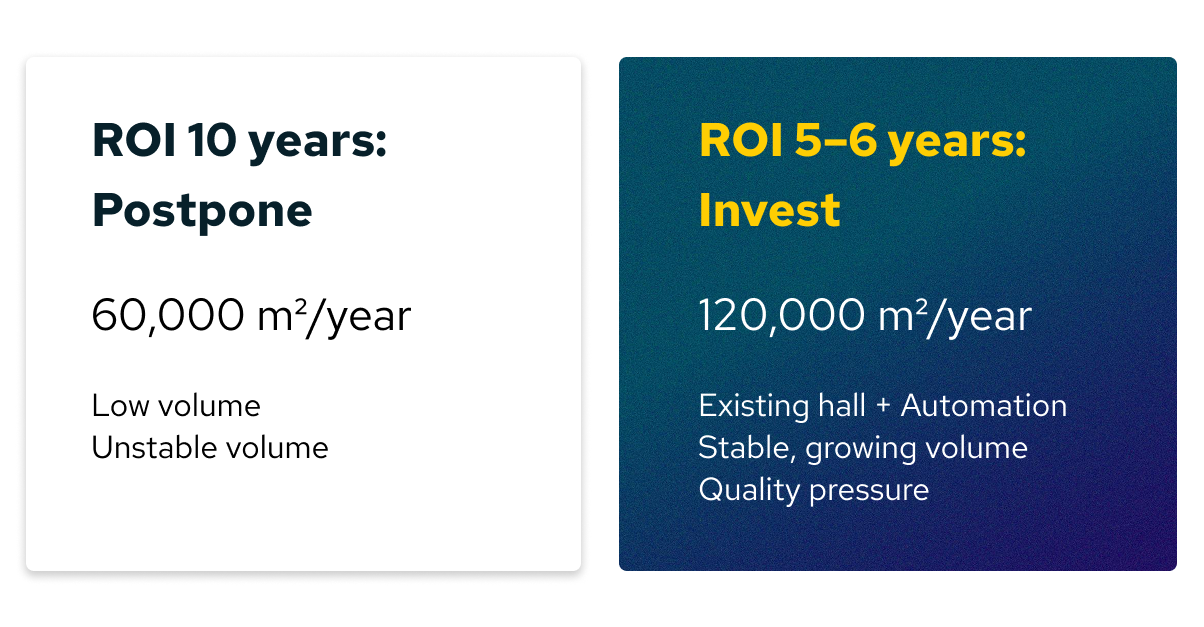
A manufacturer of steel profiles outsourced powder coating because its annual coating volume of 60,000 m² was too low to justify building an in-house paint shop. Although internal coating would have reduced costs by 1-1,5 USD per m², the required investment in a new building, paint line, and logistics resulted in a payback period of more than 10 years, so the project was postponed. One year later, the situation changed: an existing production hall became available, eliminating much of the construction cost, and a new parcel locker product line doubled the required coating volume to approximately 120,000 m² per year. At the same time, customers demanded more complex color combinations and higher quality, making robotic painting with RoboTwin an attractive option. With higher utilization, lower investment, and greater production flexibility, the estimated payback dropped to 5–6 years, turning the business case from “not yet” into “invest now.”
When does each option make sense?
The goal of these commercial coating operations is a meaningful investment into robotic coating using elements that are user-friendly and easy for the operator to use. The result is a coating cell equipped with an automatic section, for example a pre-station with robots, and at the end an application part The decision usually comes down to a mix of production volume and stability, quality requirements, lead times, and workforce availability.
Outsourcing works best with fluctuating demand, a broad product portfolio, or when speed of launch without investment is key.
An in-house paint shop pays off with stable, sufficient volumes, high repeatability requirements, and short lead times—and wherever full process control is essential.
Calculate ROI of automation for your production in 3 steps
What typically triggers the move in-house?
There are usually two main drivers:
- Cost pressure from outsourcing – this is where calculating external costs versus return on investment (ROI) becomes essential. That’s a job for company financial management and independent experts.
- Control over quality – often the decisive factor.
Even when products aren’t design-driven, industrial components today face extremely high expectations for surface finish quality. Beyond protection, the finish is a commercial factor – it helps sell the product. Achieving consistent coating quality under demanding conditions, especially with a shortage of skilled workers, is not a small task.
For a manufacturing company, outsourcing coating always carries a degree of uncertainty – the responsibility for final quality toward the end customer still lies with the manufacturer. That is why it is crucial to have clearly defined technical specifications, approval processes (samples/standards), defect catalogues, and non-conformance handling procedures.
Modern paint shop projects almost always involve a high level of automation. The focus is on minimizing the number of operators and reducing skill dependency. A clear trend here is the integration of robotic workstations. Coating is a process that can be effectively robotized, and operator work can be significantly simplified with smart setup solutions.
Among these are RoboTwin solutions, built around the principle 3 steps and 1 minute to automation: Demonstrate – Generate – Automate.
If you still don’t have enough arguments to support your decision on new coating technology and automation—don’t hesitate to reach out to RoboTwin team


FAQ
Key Questions & Answers
It depends on your production volume, quality requirements, lead times, and available resources. Outsourcing offers flexibility, while an in-house paint shop provides greater control and long-term cost benefits at stable production volumes.
An in-house paint shop is usually worth considering when production volumes are stable, quality requirements are high, and reducing lead times or outsourcing costs becomes a priority.
Outsourcing eliminates the need for large upfront investments, reduces staffing requirements, and allows manufacturers to scale coating capacity without owning a paint line.
Robotic coating improves consistency, reduces dependence on skilled labor, and helps manufacturers automate repetitive painting processes while maintaining high coating quality.
Key factors include production volume, ROI, quality requirements, operating costs, lead times, workforce availability, and the potential benefits of automation and robotic painting.