






Reading time 7 minutes
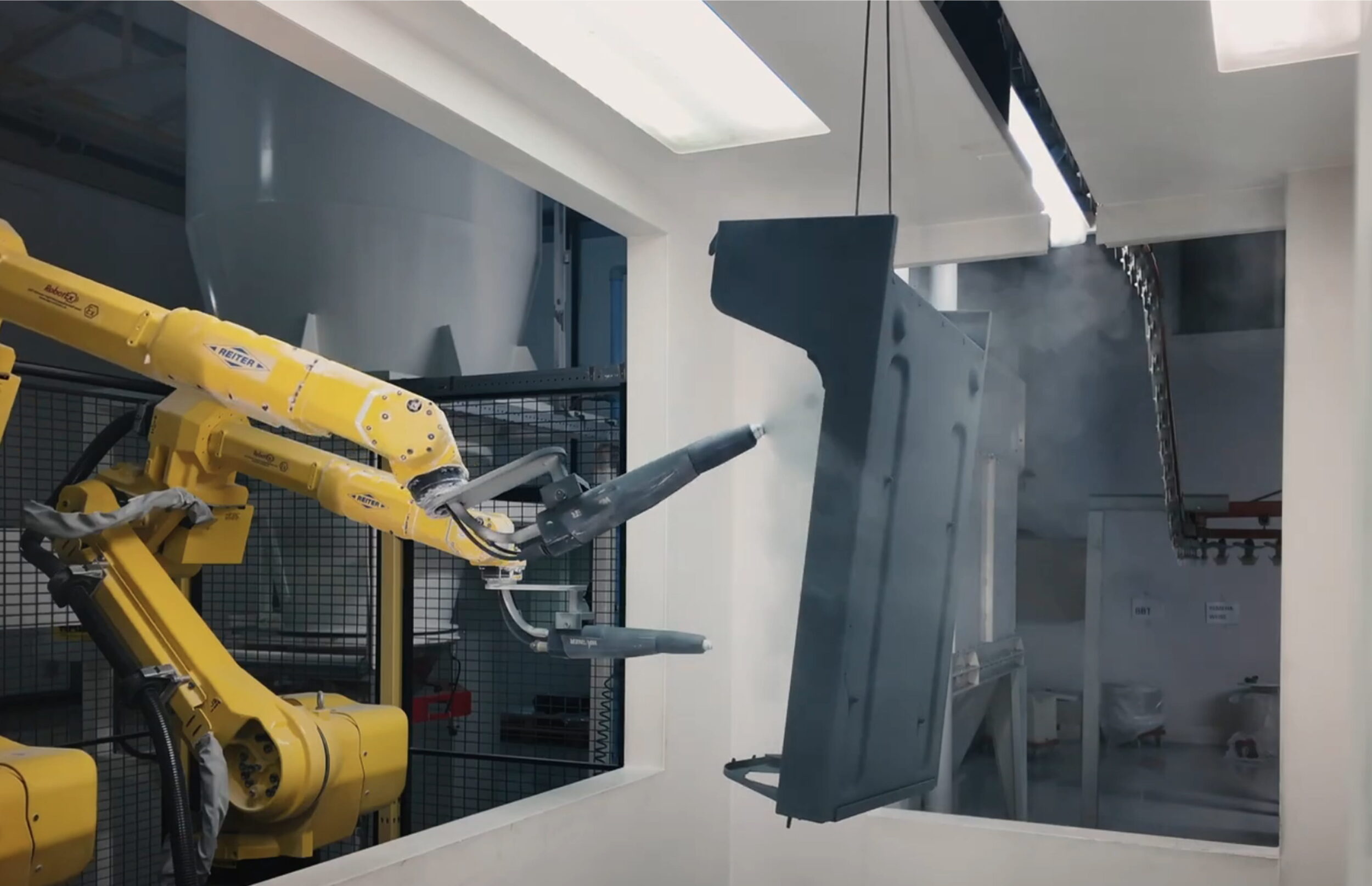
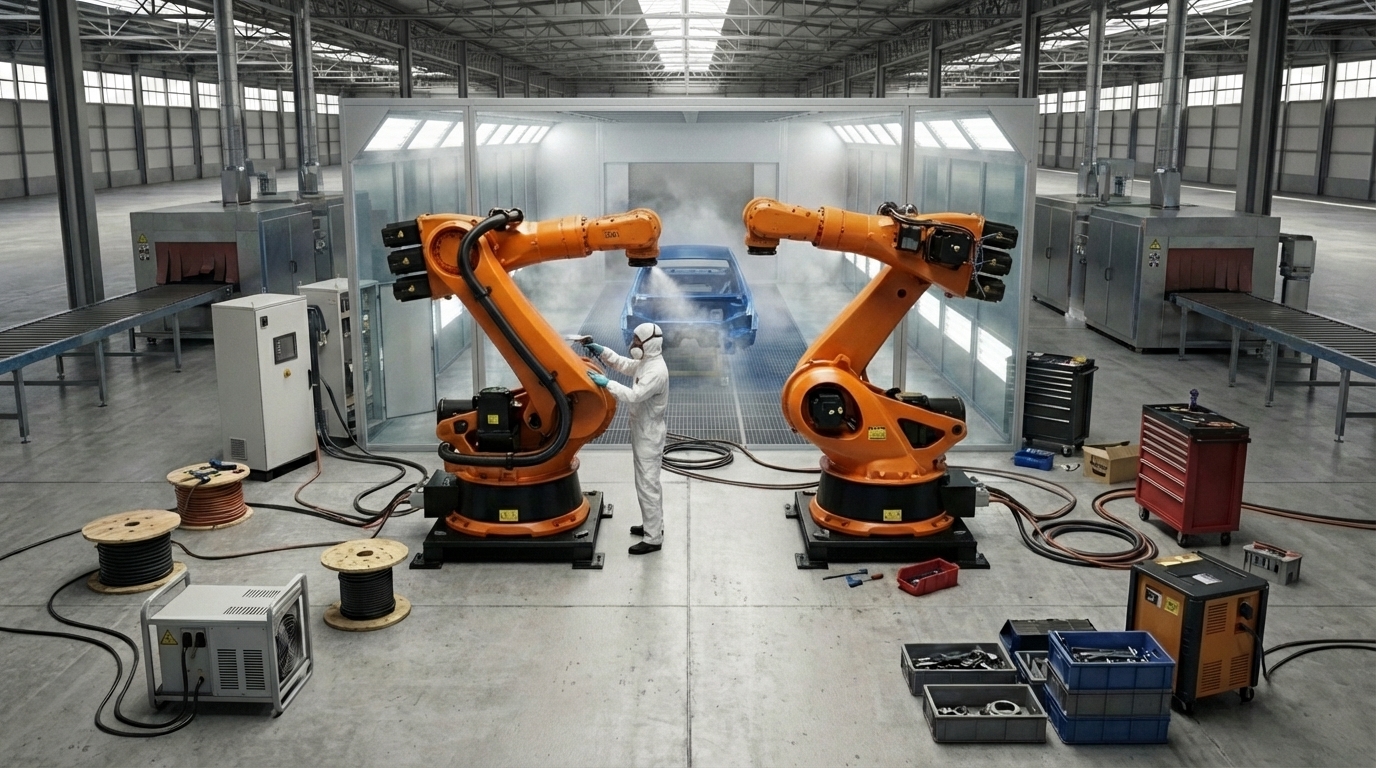
Robotization is today perhaps the most frequently discussed topic in the field of coating. Every operator in this engineering sector logically asks not only how to reduce the actual costs of coating, but also how to reduce the number of workers in the demanding environment of a paint shop / surface treatment facility.
One possible path is automated paint systems.
Cost of the automated paint booth
If we look at specific examples of powder coating shops, the robotic coating cell itself is now significantly more interesting as an investment than in previous years.
The purchase price of a robot, that is the hardware used in Industrial Painting Robots and Robots for Powder Coating, is comparable to or even lower than the cost of one worker per year (CapEx = approx. €62,000–€103,000).
“The purchase price of a robot is comparable to or lower than the annual cost of one worker.”
In this respect, there is nothing to debate if we are only talking about the payback of this part of the investment. In usual technologies for commercial mechanical coating, the robotic part will make up, for example, one-tenth of the technology cost, which is not such a fundamental parameter. In large technological complexes, it may represent only a small single-digit percentage of the total.
In the case of medium-sized paint shops, supplementing with a robotic section can mean an investment starting already from €82,000–€123,000.
The price is influenced by:
- Product size
- Number of robots and guns
- Additional axes for conveyor synchronization
Integration and robot programming software
A more demanding part is the software and the so-called integration.
Here it is no longer so easy to simply calculate or estimate how much the entire implementation will cost. It is necessary to understand several parts of the whole project.
In the first phase there is usually a feasibility study and possibly a test in the laboratory. This part is to reassure both the investor and the integrator that the whole project can be realized. The tests should prove that it is possible to achieve satisfactory coating results both in terms of quality and capacity. Everything can be realized using computer simulation, which is not so demanding, up to real tests in the paint shop.
The first phase usually includes:
- Feasibility study
- Computer simulation
- Laboratory testing
- Real paint shop testing
The decision and ROI calculation is often accompanied by a fear of technical complexity and the need for highly qualified operators — and the associated costs. In this respect, the situation is also fundamentally changing. New systems such as RoboTwin allow eliminating these high requirements and enable operating robotic coating even in normal conditions. If everything is well prepared already in the laboratory or before system deployment, the second part of the investment — that is integration — does not have to be high.
The decision and ROI calculation are often accompanied by concerns about:
- Technical complexity
- Need for highly qualified operators
- Costs of Industrial Robot Programming
“Alternatives to robot programming software such as RoboTwin allow eliminating high qualification requirements and enable robotic coating in standard industrial conditions. If everything is properly prepared in advance, integration does not have to be excessive. ”
If we return to the costs of robotization, it is the sum of the costs for the equipment and the costs for integration and robot programming.
Operational impact of automation in medium-sized paint shops
Let us consider, for example, a classic continuous paint shop with powder application. Recently, investors have had a fundamental shift in thinking about robotization.
The original idea of simply replacing a human with a robot unfortunately did not succeed so easily in practice. In practice, it is necessary to seek gradual steps that bring results and savings.
A typical paint shop usually has a continuous or Power & Free conveyor, then a booth for automatic coating using automatic guns on reciprocators / manipulators with a short stroke and then a section for manual touch-up / pre-coating or a combination of these workplaces.
Low series and pressure for very fast production times lead paint shop workers to use manual workplaces, often excessively and with all the negative impacts on the person and the result. And here is precisely the space for a modern solution.
Robotization significantly reduces the time during which the worker physically coats. It reduces the time during which they are exposed to a dusty / dangerous environment. It improves the efficiency and repeatability of coating. It often reduces the number of workers — precisely by taking over part of their work with the robot.
“In medium-sized paint shops, savings can reach tens of thousands of euros annually.”
In medium-sized paint shops, three to four workers per shift are often dedicated solely to coating due to hygiene regulations requiring rotation.
If it is a multi-shift operation, the reduction in the number of operators soon becomes apparent. Likewise, the reduction in costs for hazard pay in dangerous environments will be positively reflected. A significant parameter that generates indisputable savings is the reduction of rejects in robotic coating. Taking these savings in a medium-sized paint shop, they can be in the millions of CZK per year — equivalent to tens of thousands of euros annually.
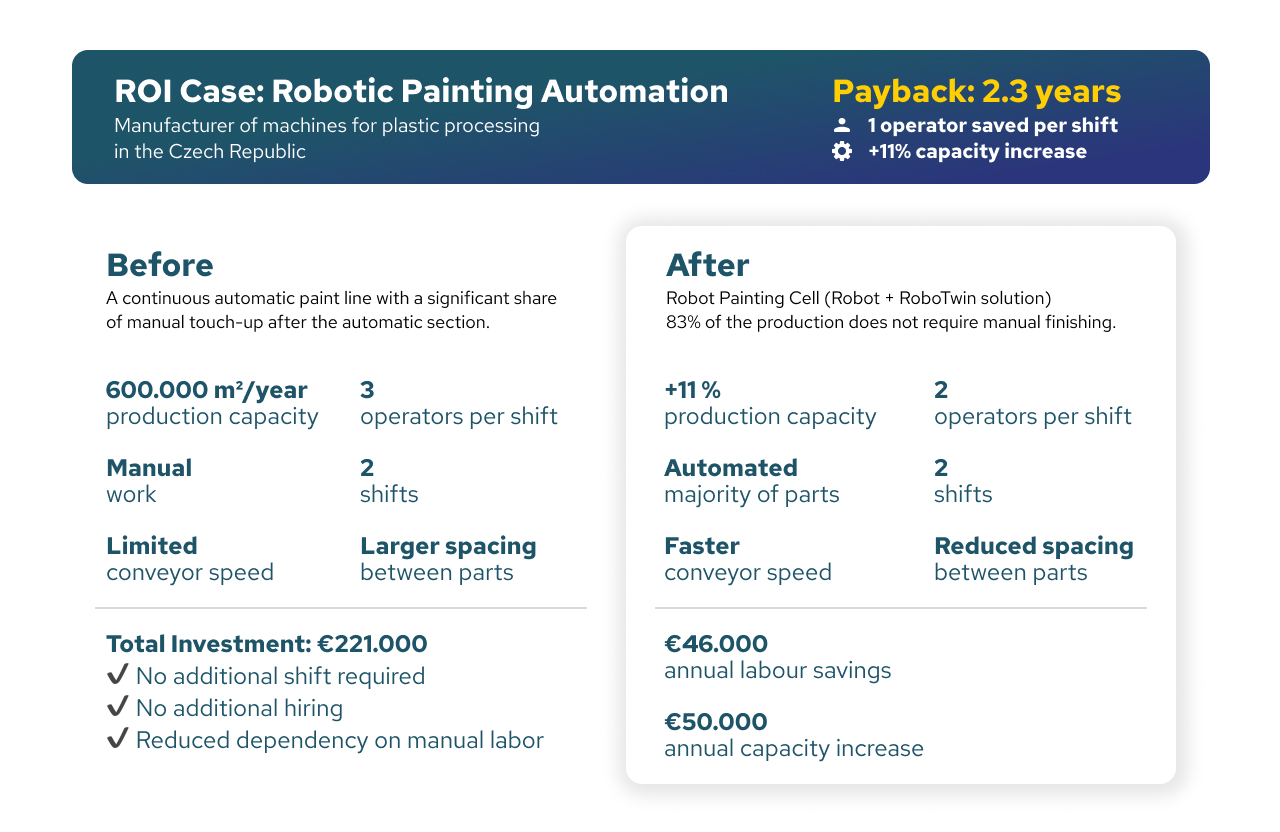
ROI and Financial Perspective
The goal of these commercial coating operations is a meaningful investment into robotic coating using elements that are user-friendly and easy for the operator to use. The result is a coating cell equipped with an automatic section, for example a pre-station with robots, and at the end an application part where the operator controls the process, makes simple corrections and, above all, coats minimally. They move from an operator in an exposed environment to a machine operator / setup technician.
Returning to the ROI calculation and the question of how much automation of a coating cell costs: an investment of €82,000–€123,000 up to €287,000–€329,000 is not an investment of large scope even for medium and small manufacturing enterprises.
“ROI is commonly achieved within approximately 2.9 years.”
Where will your investment and especially your payback be for your specific operation? In any case, our studies and also implemented projects confirm very rapid returns on robotic workstations with RoboTwin systems — in the order of several years (for example, ROI ≈ 2.9 years).


FAQ
Key Questions & Answers
Powder coating automation costs include equipment, integration, and robot programming. Industrial painting robots typically cost €62,000–€103,000, comparable to one skilled operator per year. Robotic paint shop sections usually start around €82,000 and can reach €325,000. In many coating lines, robotics represents only ~10% of total investment. Documented ROI examples are around 2.9 years.
ROI depends on labor costs, shift model, production volume, and current manual workload. Multi-shift operations usually achieve faster returns due to lower operator dependency and reduced exposure-related costs. Implemented powder coating automation projects commonly reach ROI within several years, with documented examples around 2.9 years, while also improving long-term operational stability.
Automated paint shop solutions improve coating consistency, production stability, and powder efficiency while reducing operator exposure, scrap rates, and dependency on manual labor. Multi-shift operations typically see the strongest economic impact. Companies with high employee turnover also benefit from lower recruitment, training, and operator-related operating costs.
The most demanding parts of powder coating automation are usually integration and industrial robot programming. Common concerns include commissioning risks, downtime, programming complexity, and dependence on specialists. Modern systems like RoboTwin simplify robot setup and technician training, making robotic paint shop integration more manageable in traditional industrial environments.
Industrial robot programming has historically been viewed as complex and specialist-dependent. Modern systems such as RoboTwin reduce this barrier through simplified robot programming and practical technician training. Operators can teach robot paths directly in the paint shop instead of using complex coding, shifting their role from manual spraying to process supervision and optimization.